

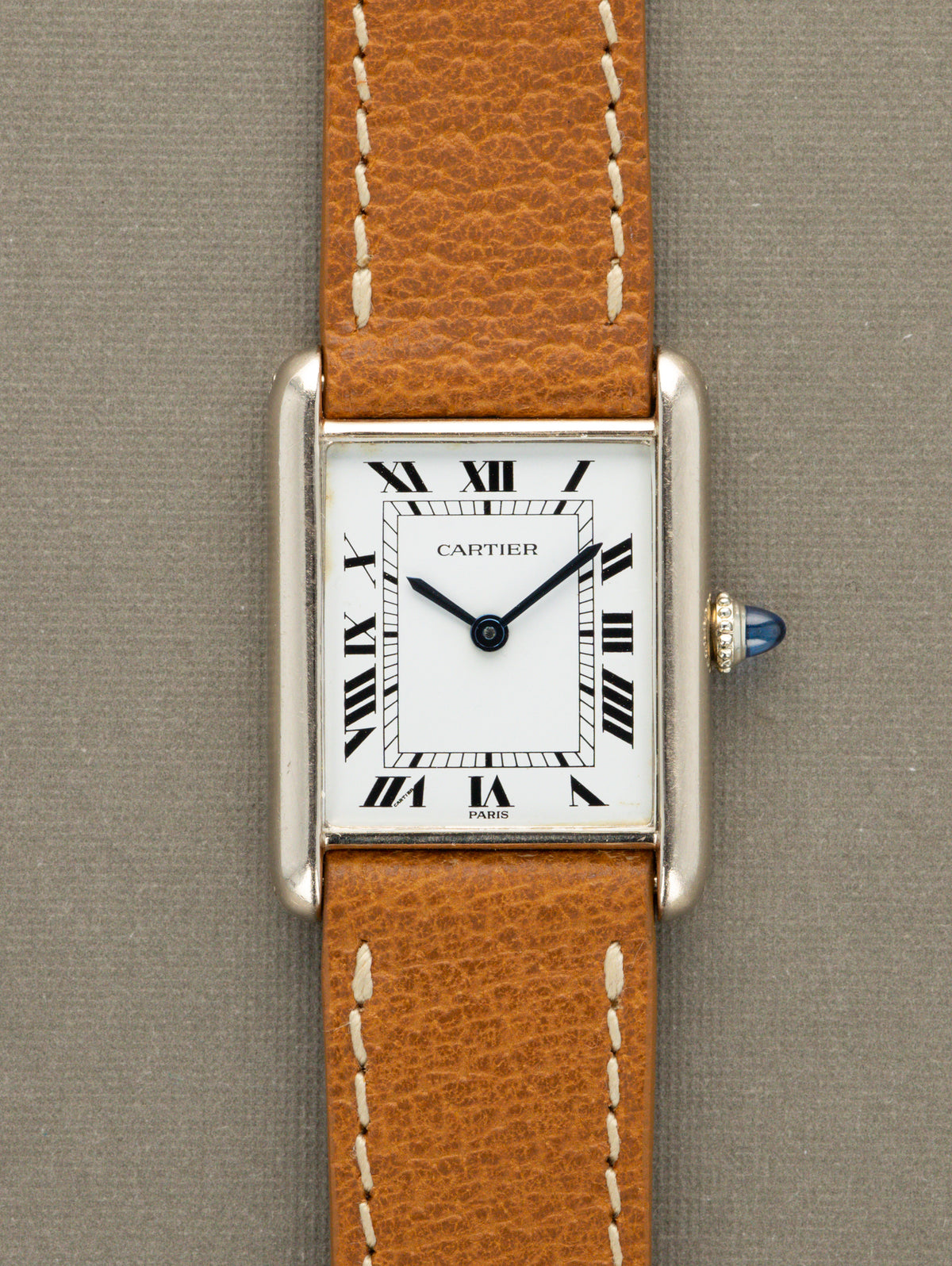
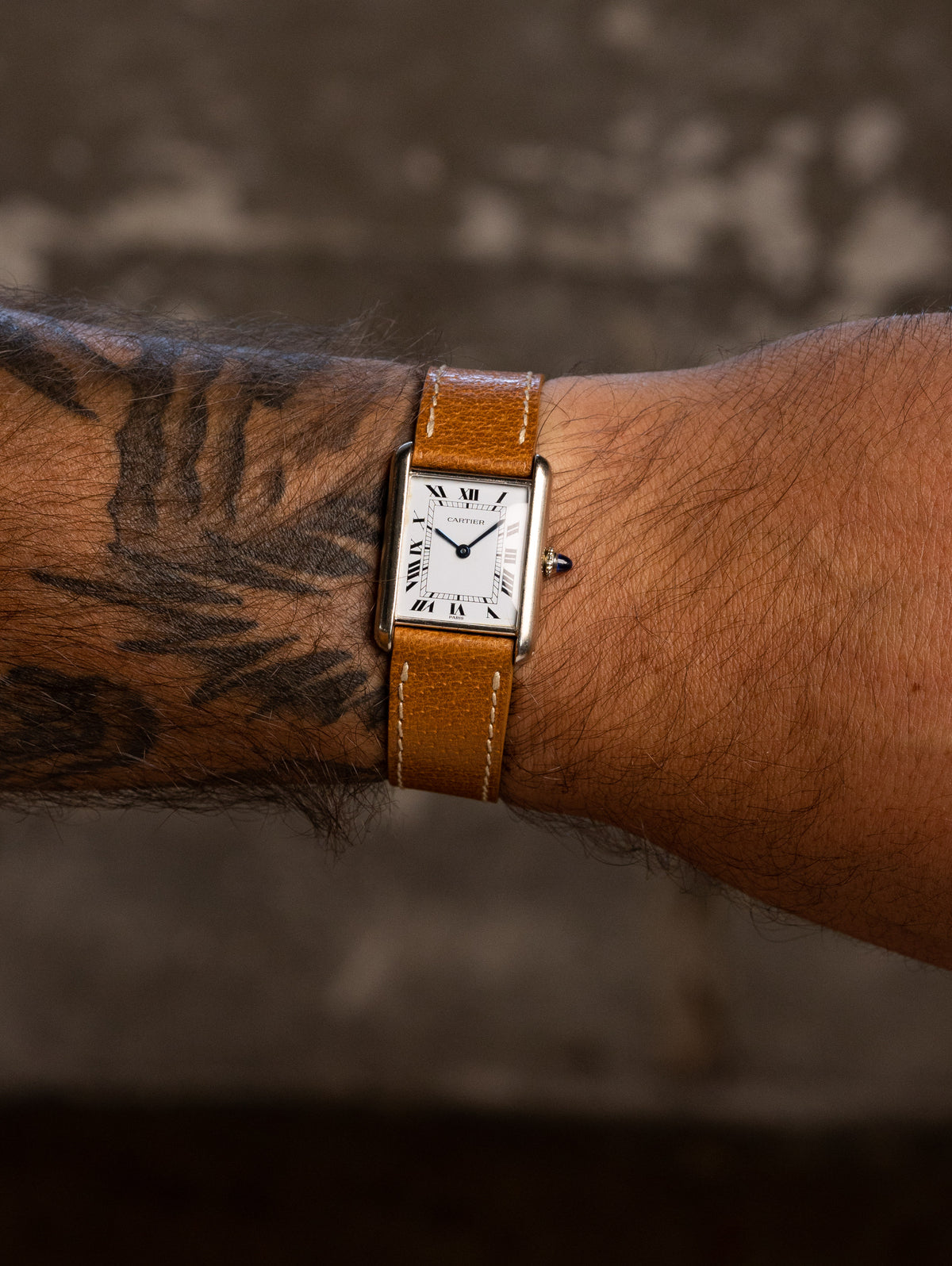
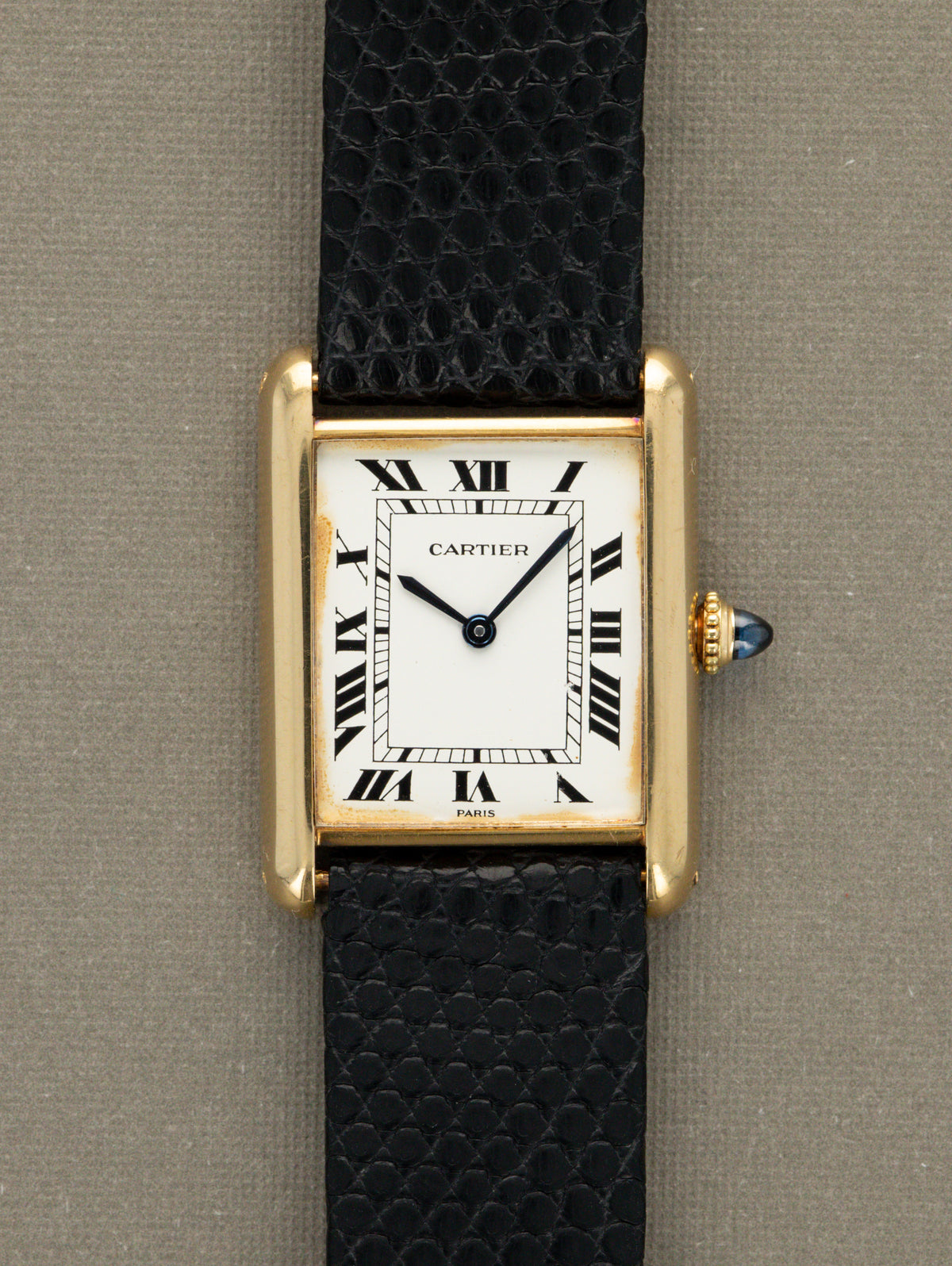
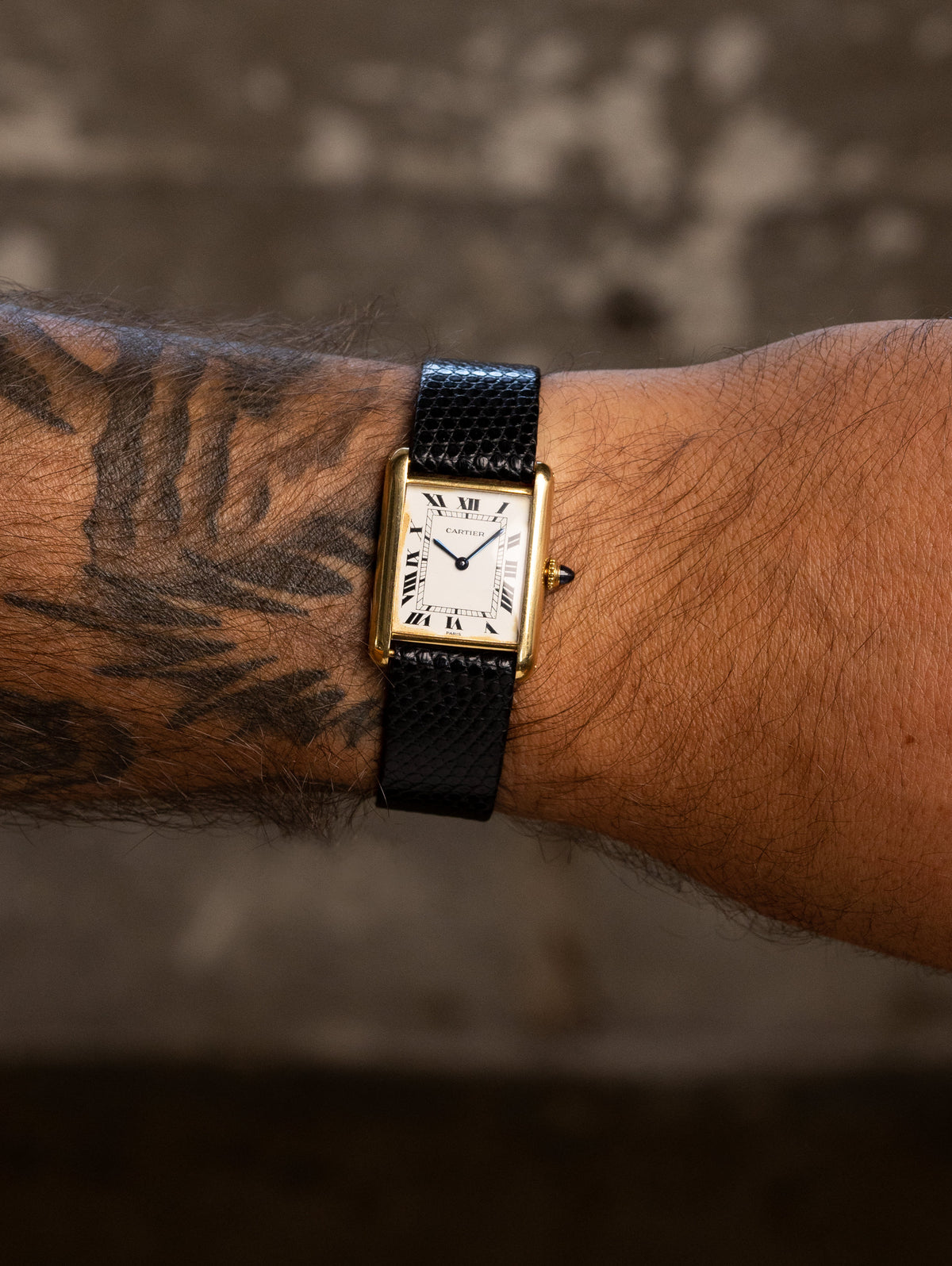


The History of Cartier Watches
Tanks, Santos and the rare Paris, London and New York pieces that collectors chase. Every one of our vintage Cartier watches is hand-selected for condition and authenticated for life.
Vintage Cartier Watches, Chosen One at a Time
Cartier did not set out to be a watch company. Instead, it was a Paris jeweler that happened to design some of the most important watch shapes of the 20th century. That is why vintage Cartier watches feel different from almost anything else. In short, they are jewelry first and machines second.
At Oliver & Clarke, we buy vintage Cartier watches in exceptional condition. That means crisp cases, original dials and movements that run the way they should. So far we have sold more than 50 Cartier watches. Most were Tanks, but we have also handled Santos, Baignoires, Ceintures and rare Paris and London pieces.
This page holds our current inventory of vintage Cartier watches. Right now, that includes a 1940s Tank "Magnum," a London Tank Cintrée, a Tank Louis "New York" and several 18k Tank Louis Cartiers. When a watch sells, it moves to the O&C Archive. There, you can see every Cartier we have handled. To browse every brand we carry, visit our full collection of vintage watches.
Below is our guide to vintage Cartier watches. First, it covers where the designs came from and the terms in our listings. Then, it explains what to check before you buy and what these watches cost today.
From the Rue de la Paix to the Wrist
The story of vintage Cartier watches runs through three cities and one family.
1847: A Paris Jeweler
Louis-François Cartier took over a Paris jewelry workshop in 1847. By the turn of the century, the house was dressing royalty. In fact, King Edward VII called Cartier "the jeweler of kings."
Three Brothers, Three Cities
Next, the founder's grandsons split the world between them. Louis ran Paris, Jacques opened London in 1902, and Pierre opened New York in 1909. As a result, vintage Cartier watches can carry a Paris, London or New York signature. Each one tells a different story about where the watch was made.
1904: The Santos
Louis Cartier designed a wristwatch for his friend Alberto Santos-Dumont, a Brazilian aviator. Santos needed to read the time without letting go of his controls. So Cartier gave him a square watch on a strap. Later, in 1911, the Santos went on sale to the public.
1917: The Tank
Then came the Tank. Louis Cartier based its shape on the tanks of the First World War, seen from above. The side rails, or "brancards," stood in for the treads. After that, Cartier spun the idea into dozens of variations. For example, the Cintrée, the Louis Cartier, the Chinoise and the Basculante all followed between 1921 and 1932.
Movements From the Best Makers
Cartier designed the cases. However, it bought movements from the best Swiss makers. In 1907, it signed an agreement with Edmond Jaeger. Then, in 1919, Cartier and Jaeger founded the European Watch and Clock Company, known as EWC. As a result, many vintage Cartier watches carry movements by EWC, Jaeger-LeCoultre, Audemars Piguet, Piaget or Movado.
The 1970s and Beyond
In the 1970s, Cartier launched "Les Must de Cartier" to reach a wider audience. Soon after, the Santos returned in 1978 with a steel-and-gold bracelet and visible screws. The Panthère followed in 1983. Today, these later models are some of the most wearable vintage Cartier watches you can buy.
The Tank on Famous Wrists
The Tank also became a style statement. For example, Andy Warhol wore one and famously said he did not wear it to tell the time. Similarly, Jacqueline Kennedy Onassis wore a Tank for decades. As a result, vintage Cartier watches carry a cultural weight that few other watches can match.
Terms Worth Knowing
Our listings for vintage Cartier watches use the same shorthand collectors use.
Paris dial. A dial signed "Cartier Paris." These watches were finished and sold by the Paris house, and they are the most collected of all vintage Cartier watches.
London dial. A dial signed "Cartier London." Cartier London cased many watches in England, often with English hallmarks. As a result, London pieces are rare and highly sought after.
New York dial. A dial signed "Cartier New York." Many New York pieces were cased in America, partly to reduce import duties.
Swiss dial. A dial signed "Swiss" or "Swiss Made." These come from later Swiss production, and they usually cost less than Paris dials.
Brancards. The two vertical side rails of a Tank case. In fact, crisp brancards are the first thing we check.
Lignes. An old French measure of movement size. For example, a Tank Cintrée "7 Lignes" holds a smaller movement than an "8 Lignes."
Cabochon crown. A rounded crown set with a sapphire or spinel. It is a Cartier signature, especially on the Tank Louis.
Secret signature. The word "Cartier" hidden inside one of the Roman numerals, often the VII or the X. Many later vintage Cartier watches have one.
EWC. The European Watch and Clock Company, the movement maker Cartier founded with Edmond Jaeger in 1919.
Extra Plate. French for "extra thin." Cartier used it for its slimmest quartz and mechanical models.
Must de Cartier. Cartier's 1970s line, often in vermeil, which is gold-plated silver. It is a more affordable way into vintage Cartier watches.
Vermeil. Sterling silver plated with gold. Most Must de Cartier Tanks are vermeil, so they cost less than solid gold.
Deployant buckle. A folding clasp on a leather strap. In fact, an original 18k Cartier deployant adds real value.
Grain de riz. French for "grain of rice," a bracelet made of small rounded links. It suits the slim Tank Louis Extra Plate perfectly.
Massif. Solid gold. For example, a Santos "Massif" has a solid gold case and bracelet, rather than steel and gold.
The Tank, Model by Model
The Tank is the heart of most vintage Cartier watches. In fact, we have sold more Tanks than any other Cartier. These are the versions we see most often.
Tank Normale
The original 1917 shape, with straight brancards and a flat case, is where vintage Cartier watches begin. Today, it is the purest of all vintage Cartier watches.
Tank Louis Cartier
Introduced in 1922, the Tank Louis softened the rails into rounded edges. It is the most popular of our vintage Cartier watches. For example, we often carry the 18k ref. 78086 in yellow and white gold, plus the smaller ref. 78087 for ladies.
Tank Cintrée
Long, slim and curved to follow the wrist, the Cintrée arrived in 1921. Above all, early Paris and London examples are some of the most beautiful vintage Cartier watches ever made.
Tank Chinoise
Inspired by Chinese temple architecture, the Chinoise adds bold horizontal bars above and below the dial. As a result, it looks more architectural than any other Tank. It is one of the boldest vintage Cartier watches.
Tank Basculante
Introduced in 1932, the Basculante flips over in its frame to protect the crystal. In other words, it is Cartier's answer to the reversible watch, and one of the cleverest vintage Cartier watches ever made.
Tank "Magnum" and Large Tanks
In the 1940s, Cartier made a handful of oversized Tanks, often with LeCoultre movements. Today, these large Tanks are some of the rarest vintage Cartier watches we see.
Tank Automatique and Tank Américaine
Later Tanks added automatic movements and larger cases. For example, the Tank Automatique "Jumbo" XL suits collectors who want a bigger Tank.
Tank Louis Extra Plate
The ref. 96065 Extra Plate is one of the slimmest Tanks Cartier ever made. In addition, it often comes on a grain de riz bracelet or with a silver guilloché dial. As a result, it is one of the most refined vintage Cartier watches for a dress occasion.
Tank Américaine
Introduced in 1989, the Américaine stretches the Tank into a longer, curved case. In other words, it takes the Cintrée idea and makes it easier to wear every day.
Vintage Cartier Watches Beyond the Tank
The Tank gets the attention. Still, some of the most interesting vintage Cartier watches have nothing to do with it.
Santos
First, there is the Santos, Cartier's oldest wristwatch design. The 1978 Santos de Cartier added a screwed bezel and an integrated bracelet. In addition, the ref. 2960 Santos Carrée and the solid gold "Massif" are some of our best sellers.
Santos-Dumont
The Santos-Dumont keeps the original square shape on a leather strap. As a result, it is slimmer and dressier than the bracelet Santos.
Baignoire
The Baignoire, French for "bathtub," uses an elongated oval case. It dates back to 1912. Today, it is one of the most elegant vintage Cartier watches for a smaller wrist.
Ceinture and Vendôme
The Ceinture borrows its shape from a belt buckle. Meanwhile, the Vendôme pairs a round dial with distinctive lugs. Both are elegant, wearable vintage Cartier watches, and both are still good value.
Cristallor, Incurvée and Rare Shapes
Cartier also made round, curved and asymmetrical pieces. For example, we have sold the Cristallor with a white enamel dial and a curved Incurvée with a JLC movement.
Panthère
Introduced in 1983, the Panthère pairs a square case with a supple bracelet. Similarly, it has become one of the most wanted 1980s vintage Cartier watches.
Santos Galbée and Santos Octagon
The Santos Galbée adds a gently curved case to the 1978 design. Meanwhile, the Santos Octagon swaps the square bezel for eight sides. For example, we have sold a Galbée with a moonphase and an Octagon with a burgundy lacquer dial. Both are less common vintage Cartier watches, and both are good value.
Clocks and Objects
Cartier made extraordinary desk clocks too. For example, our current inventory includes a lapis lazuli minute repeater clock with an EWC movement.
Cartier by Other Makers
Finally, some Cartier pieces were made by other great houses. For more, see our vintage Audemars Piguet watches and our vintage Movado watches.
What to Look For Before You Buy
Condition decides the value of vintage Cartier watches more than anything else. In particular, these slim gold cases are easy to damage.
The Case
On vintage Cartier watches, look for sharp brancards and clean edges. A heavy polish rounds them off and thins the gold. So we always say when a case is unpolished.
The Dial
The dial is often half the value. Therefore, check that the signature matches the watch, whether Paris, London, New York or Swiss. Also check that the printing is crisp. A refinished dial almost always lowers the value.
The Crown
On vintage Cartier watches, the cabochon should be the right shape and color for the model. However, crowns are often replaced during service. We always tell you if one has been.
The Movement
Many vintage Cartier watches use movements by EWC, Jaeger-LeCoultre or other great makers. So ask what is inside, and whether it has been serviced. Every one of our vintage Cartier watches is sold running.
Papers and Hallmarks
Original boxes, papers and service records all add value. In addition, case numbers and hallmarks help confirm where and when a watch was made.
The Buckle
An original Cartier buckle adds value, especially an 18k deployant. However, buckles are often lost or replaced. So we always note whether the buckle is original, gold or a later replacement.
Quartz Models
Many 1980s and 1990s vintage Cartier watches use quartz movements. They are reliable and easy to live with. Still, check for any sign of battery leakage, and ask when the battery was last changed.
Hallmarks and Case Makers
Hallmarks tell you a lot about a Cartier. For example, French gold cases usually carry the eagle's head mark for 18k gold. Meanwhile, London cases often carry English hallmarks and a case maker's mark. In addition, the case number should be stamped cleanly on the caseback. Together, these details help confirm which branch made the watch and when.
How to Choose
There is no wrong way into vintage Cartier watches. Still, a few questions narrow it down quickly.
Start With Size
Most vintage Cartier watches are small by today's standards. For example, a Tank Louis is about 23 by 30mm. Even so, the long shape wears larger than the numbers suggest.
Pick a Shape
A Tank Louis goes with everything. By contrast, a Cintrée is longer and more striking. Meanwhile, a Santos wears more like a sports watch.
Paris or Swiss
Paris, London and New York dials carry a premium on vintage Cartier watches. On the other hand, a Swiss-dial Tank gives you the same design for less.
Gold Color
Yellow gold is the classic choice for a Tank. On the other hand, white gold is quieter and rarer. Meanwhile, steel-and-gold Santos models are the easiest vintage Cartier watches to wear every day.
Everyday or Occasion
A Santos or a Tank Louis can be worn daily. By contrast, a Cintrée, a Chinoise or an Extra Plate is better kept for evenings and special occasions.
Mechanical or Quartz
Mechanical Tanks are the most collected. They also need winding and regular service. By contrast, quartz models are simple to own and cost less. So the right choice depends on how you plan to wear the watch. If you want a collector's piece, choose mechanical. If you want an easy daily watch, quartz is a smart option.
Strap or Bracelet
Most Tanks wear on leather. So a good strap matters. Our leather watch straps are cut to suit vintage cases and lug widths.
Ask Us
Finally, ask for extra photos, a video or our honest opinion on any of our vintage Cartier watches. We are also glad to compare pieces in our inventory and the Archive.
What Vintage Cartier Watches Cost
Prices for vintage Cartier watches cover a wide range. In general, the model and the dial matter more than the name.
The Price Bands
Under $10,000: ladies' Tank Louis, Swiss-dial Tanks, the Vendôme, the Ceinture, the Baignoire and steel-and-gold Santos Carrées.
$10,000 to $20,000: most Paris-dial Tank Louis Cartiers, the Santos-Dumont, Extra Plate Tanks, the Panthère and the Tank Automatique XL.
$20,000 to $35,000: white gold Tank Louis, the Tank Cintrée, the Tank Chinoise, the Cristallor, the Incurvée and the solid gold Santos "Massif."
$35,000 and above: London Cintrées, the Tank Basculante, dual time Tanks and 1940s large Tanks such as the "Magnum."
What Moves a Price
Five things decide what vintage Cartier watches are worth. First, the model and the city on the dial. Next, the condition of the case. Then, the originality of the parts. Finally, whether the box and papers survive.
Why Dial Signatures Matter
A Paris or London dial can double the price of an otherwise similar watch. That is because these watches were made in small numbers. As a result, they are some of the most sought-after vintage Cartier watches today.
Must de Cartier and Quartz
Must de Cartier Tanks in vermeil and quartz models from the 1980s and 1990s are the most affordable vintage Cartier watches. In fact, they are a great first Cartier. However, they do not carry the same premium as solid gold mechanical watches, so we price them accordingly.
Buying From Oliver & Clarke
We built Oliver & Clarke around the experience we wanted when buying vintage watches ourselves.
Authenticated for Life
All of our vintage Cartier watches are inspected by our specialists. In addition, authenticity is guaranteed for life.
One-Year Warranty
All of our vintage Cartier watches also come with a one-year mechanical warranty from delivery.
72-Hour Inspection Period
You have 72 hours after delivery to inspect your watch in person. See our shipping, returns and warranty page for full terms.
Visit the Showroom
Of course, you can also see any of our vintage Cartier watches in person at our Los Angeles showroom, 6363 Wilshire Boulevard, by appointment.
Sell or Trade
We buy and trade vintage Cartier watches, from Tanks to Santos. Send us yours through Sell Your Watch.
Other Brands
Many Cartier collectors also love classic gold dress watches. So see our vintage Patek Philippe watches for the Calatrava and Ellipse.
Our View, After Dozens of Tanks
Life is too short to wear a boring watch. And few watches are less boring than a great Cartier.
First, the case is everything. The best vintage Cartier watches still have sharp brancards and clean edges.
Second, the city matters on vintage Cartier watches. A Paris or London dial is worth seeking out.
Third, small is beautiful. A vintage Tank wears better than its size suggests.
Fourth, start with a Tank Louis. It is the easiest Cartier to wear, and it never looks out of place. After that, branch out to a Cintrée, a Santos or a rarer shape.
Fifth, look after the strap. A fresh, well-made strap changes how a Tank wears more than almost anything else.
Finally, the best vintage Cartier watches go fast. If you see one you love here, it may be in the Archive next week.
Vintage Cartier Watches Questions
Which vintage Cartier watches are most collectible?
Early Tank Cintrées, Tank Normales and Tank Louis Cartiers with Paris or London dials are the most collected vintage Cartier watches. Rare shapes like the Tank Basculante, the Tank Chinoise and 1940s large Tanks follow close behind. In addition, the solid gold Santos is rising fast.
Collectibility comes down to design history, rarity and condition. The Tank is Cartier's most important design, so early examples carry the strongest demand. In particular, a Paris or London signature adds a large premium, because those watches were made in small numbers. Meanwhile, shapes Cartier made only briefly, such as the Basculante or the Tank "Magnum," are rarer still. Later models matter too. For example, the 1978 Santos and the 1983 Panthère have grown quickly as collectors discover how well they wear. Whatever the model, condition matters most. So an honest, unpolished example of a common reference usually holds its value better than a tired example of a rare one. Finally, our Archive shows the vintage Cartier watches we have sold, which is a good guide to what collectors want.
What do Paris, London and New York dials mean?
The city on the dial shows which Cartier branch finished and sold the watch. Paris dials come from the original Paris house. London and New York dials come from the branches Jacques and Pierre Cartier opened in 1902 and 1909. All three are more collected than later Swiss dials.
In the early and mid 20th century, each Cartier branch worked somewhat independently. For example, Cartier London often cased its watches in England, so many London pieces carry English hallmarks. Similarly, Cartier New York cased many watches in America, partly to reduce import duties. As a result, two Tanks of the same model can differ in case details, depending on the city. Later, production moved to Switzerland, and dials were signed "Swiss" or "Swiss Made." Today, Paris and London dials are the most sought after, and they can double the price of an otherwise similar watch. However, a Swiss-dial Tank still offers the same design for less. When we list vintage Cartier watches, we always state the dial signature, the case maker where known and any hallmarks.
What is the difference between the Tank models?
The Tank Normale is the original 1917 shape, with straight side rails. The Tank Louis Cartier, from 1922, has softer rounded edges. Meanwhile, the Tank Cintrée is long and curved to follow the wrist. The Chinoise and Basculante are rarer variations from the 1920s and 1930s.
Every Tank shares the same idea: a rectangular dial framed by two vertical rails, called brancards. However, each model plays with that idea differently. The Tank Louis is the most versatile, so it is our most popular Cartier. By contrast, the Cintrée is more dramatic, and it wears long on the wrist. The Chinoise adds bold horizontal bars, like a temple portico. Meanwhile, the Basculante pivots in its frame to protect the crystal. Later, Cartier added the Tank Américaine and the Tank Automatique, with larger curved cases. In addition, the Must de Cartier Tanks of the 1970s brought the shape to a wider audience in vermeil. So the best Tank for you depends on your wrist and your style. Ask us, and we will compare models from our inventory and the Archive.
How do you authenticate vintage Cartier watches?
Our specialists check every case number, hallmark and dial signature against what is correct for the model and year. Then they inspect the crown, hands, buckle and movement. Authenticity is guaranteed for life on all of our vintage Cartier watches.
Cartier is one of the most copied names in the world, so authentication needs real experience. First, we look at the case construction and finishing, including the brancards and the caseback screws. Next, we check the dial printing, the signature and any secret signature in the numerals. Then we open the watch and confirm the movement is correct, whether by EWC, Jaeger-LeCoultre or another maker. We also check that the parts belong together. After all, a genuine watch can still carry a replacement crown, a refinished dial or later hands. In addition, anything that has been replaced is described in the listing in plain language. Our specialists include people who came from Sotheby's and Analog:Shift. Finally, if you ever have a question about a Cartier you bought from us, contact our team and we will look at it again.
Who made the movements in vintage Cartier watches?
Cartier designed its cases, but it bought movements from the best Swiss makers. Many vintage Cartier watches use movements by EWC, the company Cartier founded with Edmond Jaeger in 1919, or by Jaeger-LeCoultre. Others use movements by Audemars Piguet, Piaget, Movado and Frédéric Piguet.
This partnership approach was common among great jewelers. In fact, Cartier's agreement with Edmond Jaeger in 1907 led to some of the thinnest and finest movements of the era. As a result, the movement inside a vintage Cartier can be as interesting as the case. For example, a 1940s Tank with a LeCoultre movement or a Cartier made by Audemars Piguet appeals to collectors of both houses. Later, from the 1970s, many Cartier watches used reliable quartz or automatic movements, which makes them easy to live with. However, quartz models still need care, because old batteries can leak. When we list vintage Cartier watches, we always name the movement maker where known. We also note whether the watch has been serviced and whether any parts were replaced.
What size vintage Cartier should I buy?
Most vintage Cartier watches are small by today's standards. For example, a Tank Louis measures roughly 23 by 30mm. Even so, the rectangular shape wears larger than a round watch of the same size. Larger wrists suit a Cintrée, a Tank Automatique XL or a Santos.
Size is the most common question we get about vintage Cartier watches. The good news is that a small Tank looks elegant on almost any wrist. In fact, many collectors find that a classic Tank Louis feels right, even if they usually wear larger watches. However, if you prefer more presence, look at the longer Cintrée or a 1940s large Tank. Similarly, the Santos and Panthère wear larger because of their bracelets. For smaller wrists, the ladies' Tank Louis and the Baignoire are ideal. Also remember that the strap changes how a watch wears. A slim, tapered strap makes a Tank feel more refined. Finally, visit our Los Angeles showroom to try sizes in person, or ask for wrist shots and measurements of any of our vintage Cartier watches.
How much do vintage Cartier watches cost?
Our vintage Cartier watches start under $10,000 for ladies' Tanks, Swiss-dial Tanks, the Vendôme and steel-and-gold Santos models. Most Paris-dial Tank Louis Cartiers sit between $10,000 and $25,000. Meanwhile, London Cintrées, Basculantes and 1940s large Tanks run higher.
Five things decide what vintage Cartier watches are worth: the model, the dial signature, the case condition, the originality of the parts and the box and papers. In particular, a Paris or London dial can add a large premium. Similarly, an unpolished case with sharp brancards is worth far more than a heavily polished one. Market demand moves too. For example, Tank prices have risen sharply in recent years, as more collectors discover vintage dress watches. Even so, many Cartier models remain good value compared with similar watches from Patek Philippe. We price every watch against recent sales of comparable examples. In fact, fair, transparent pricing is our founding mission. If you share your budget, our team can point you to the Cartier that makes the most of it.
Do your vintage Cartier watches come with a warranty?
Yes. Every watch comes with a one-year mechanical warranty from the date of delivery, and authenticity is guaranteed for life. However, water resistance is not guaranteed on vintage watches, so keep vintage Cartier watches away from water.
The warranty covers the movement and is not transferable. In addition, many of our vintage Cartier watches have been serviced by our watchmakers before sale, and every one is sold running. If something goes wrong within the warranty period, contact our team and we will arrange a repair. Gaskets and seals age over time. That is why we do not guarantee water resistance on any vintage watch. Cartier cases are often thin, so avoid knocks and keep the watch away from strong magnets. Also, have it serviced every five to seven years by someone who knows the movement. You also have 72 hours after delivery to inspect your watch in person. Finally, full terms are listed on our shipping, returns and warranty page, and our team is glad to explain them before you buy.
How should I care for a vintage Cartier?
Keep it dry, avoid knocks and never let a jeweler polish the case. In addition, change the strap when it wears, and plan a service every five to seven years. For quartz models, replace the battery before it runs flat, because old batteries can leak.
The thin gold cases on vintage Cartier watches are the most delicate part. A routine polish can soften the brancards and thin the gold. That lowers both the look and the value. So always ask for the case to be cleaned only. Next, look after the strap. Leather wears with use, and a tired strap can fail at the buckle. Our leather watch straps are cut to suit vintage cases and lug widths. Then, check the crown. Cabochon crowns can loosen or chip, so have them checked during service. Meanwhile, store the watch somewhere dry and away from magnets. Finally, wind manual watches once a day, at roughly the same time. Our team is glad to advise on care for any Cartier you buy from us.
Do you buy or trade vintage Cartier watches?
Yes. We buy and trade vintage Cartier watches, especially Tanks, Santos and rare Paris and London pieces. Send photos and details through our Sell Your Watch page. Our team will review your watch and come back to you with an offer.
First, clear photos of the dial, case, caseback, crown, buckle and any papers help us give you an accurate offer quickly. Next, tell us what you know about the watch's history. That includes service records, original purchase details and any certificate from Cartier. Original boxes and papers add value on vintage Cartier watches, so include them if you have them. We buy outright or take watches in trade toward a piece in our inventory. For example, a trade can be a smart way to move from a Swiss-dial Tank to a Paris dial. Our offers are based on condition, originality and recent market sales, the same way we price our own watches. Finally, every watch we buy is inspected the same way as the watches we sell.
What is a Cartier secret signature?
A secret signature is the word "Cartier" hidden inside one of the Roman numerals on the dial, usually the VII or the X. It is a small security mark that Cartier added to many watches, and you often need a loupe to see it.
Collectors love secret signatures because they are both charming and useful. On the one hand, they are a quiet detail that most people never notice. On the other hand, they help confirm that a dial is genuine and correct. However, not every vintage Cartier has one. In fact, many early Paris and London dials predate the practice, so a missing signature is not a problem on its own. Instead, what matters is that the dial matches the model, the period and the city. When we list vintage Cartier watches, we describe the dial in detail, including any secret signature. If you are unsure about a dial on a watch you own, send us clear photos. Our team will be glad to take a look.
Find Your Next Cartier at Oliver & Clarke
New vintage Cartier watches join our inventory regularly, and the best ones rarely last. Every piece is authenticated for life, covered by a one-year mechanical warranty and described down to the last mark. Want to know who you are buying from? Read our story.
Looking for a specific Tank, or want to see a watch in person? Book an appointment at our Los Angeles showroom, or tell us what you are hunting for and we will look for it. Selling or trading? Start with Sell Your Watch. For anything else, visit Customer Care or email info@oliverandclarke.com.